Example SCI-069: Return counted as a full case — Returned cases may be partially filled.
What goes wrong: This full-case toy is a warning to validate partial return inputs. How we fix it: Order the necessary whole cases using the verified conversion.
Interactive calculator loads automatically in modern browsers. All plain-English explanations, units, and tables are shown directly on this page.
Visual Before-and-After Chart (SCI-069)
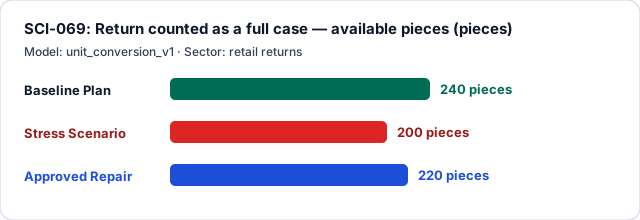
Key Question to Ask: Inspect verified piece count rather than reusing shipment pack size.
How to Fix It: Order the necessary whole cases using the verified conversion.
Simple Summary of This Example
- Example Number:
SCI-069(retail returns) - Plain-English Topic: How Mixing Up Box Sizes (12 per Box vs. 10 per Box) Creates Instant Shortages
- Main Goal: reconcile data before promising stock
- Important Limit: No weight-to-volume inference or unapproved substitution.
Starting Numbers & Units for SCI-069
| Number Name | Unit of Measure | Starting Value | Allowed Range |
|---|---|---|---|
available cases (available_cases) |
whole cases | 20 | 0 to 1000000 (integer) |
assumed case size (assumed_case_size) |
pieces per case | 12 | 1 to 1000000 (integer) |
actual case size (actual_case_size) |
pieces per case | 10 | 1 to 1000000 (integer) |
demand pieces (demand_pieces) |
pieces | 215 | 0 to 1000000 (integer) |
Compare Normal Day vs. Problem Day vs. Fixed Plan (SCI-069)
| Result Name | Unit | Normal Day (Baseline) | Problem Day (Stress) | Fixed Plan (Repair) |
|---|---|---|---|---|
available pieces (available_pieces) |
pieces | 240 | 200 | 220 |
shortage pieces (shortage_pieces) |
pieces | 0 | 15 | 0 |
extra cases needed (extra_cases_needed) |
whole cases | 0 | 2 | 2 |
Other Related Examples on "How Mixing Up Box Sizes (12 per Box vs. 10 per Box) Creates Instant Shortages"
- SCI-064: A case is not always twelve — The current case contains ten pieces.
- SCI-065: Vendor pack changed — A vendor changes the inner carton quantity.
- SCI-066: Sales unit and stock unit — Sales promises pieces while stock is recorded in cases.
- SCI-067: Imported unit default — An import defaults a missing pack size to twelve.
- SCI-068: Sample pack mixed with full pack — Sample cases contain fewer pieces.
- SCI-069: Return counted as a full case (This Page)
- SCI-070: Revision conversion audit — A packaging revision changes unit count.