Example SCI-074: Payday demand concentration — Demand clusters in the first planning period.
What goes wrong: Flat receipts do not automatically match concentrated demand. How we fix it: Preposition the declared buffer before period one begins.
Interactive calculator loads automatically in modern browsers. All plain-English explanations, units, and tables are shown directly on this page.
Visual Before-and-After Chart (SCI-074)
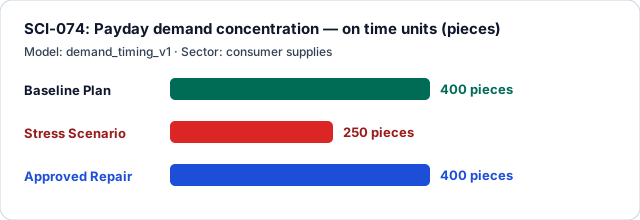
Key Question to Ask: Inspect within-horizon demand distribution instead of the total.
How to Fix It: Preposition the declared buffer before period one begins.
Simple Summary of This Example
- Example Number:
SCI-074(consumer supplies) - Plain-English Topic: Why an Early Rush in Week 1 Causes Shortages Even When Monthly Sales Stay Equal
- Main Goal: protect due-period service
- Important Limit: Four periods; constant receipts; backlog is retained.
Starting Numbers & Units for SCI-074
| Number Name | Unit of Measure | Starting Value | Allowed Range |
|---|---|---|---|
opening stock (opening_stock) |
pieces | 20 | 0 to 1000000 (integer) |
receipt per period (receipt_per_period) |
pieces | 100 | 0 to 1000000 (integer) |
base demand (base_demand) |
pieces | 100 | 0 to 1000000 (integer) |
pull forward (pull_forward) |
pieces | 70 | 0 to 1000000 (integer) |
extra buffer (extra_buffer) |
pieces | 50 | 0 to 1000000 (integer) |
Compare Normal Day vs. Problem Day vs. Fixed Plan (SCI-074)
| Result Name | Unit | Normal Day (Baseline) | Problem Day (Stress) | Fixed Plan (Repair) |
|---|---|---|---|---|
on time units (on_time_units) |
pieces | 400 | 250 | 400 |
late units (late_units) |
pieces | 0 | 150 | 0 |
ending stock (ending_stock) |
pieces | 20 | 20 | 70 |
peak backlog (peak_backlog) |
pieces | 0 | 50 | 0 |
Other Related Examples on "Why an Early Rush in Week 1 Causes Shortages Even When Monthly Sales Stay Equal"
- SCI-071: Correct month wrong week — Demand moves from the last period to the first.
- SCI-072: Campaign launches early — A campaign begins before the approved calendar.
- SCI-073: Customer pulls order forward — A customer advances part of a later commitment.
- SCI-074: Payday demand concentration (This Page)
- SCI-075: School opening calendar shift — An opening date changes the first demand peak.
- SCI-076: Weather event brings demand forward — A fictional event shifts the timing of existing demand.
- SCI-077: Distributor prebooking — A distributor requests earlier prepositioning.