Example SCI-091: Extra input needs capacity — More input is only useful if processing can handle it.
What goes wrong: The calculation shows material need while feasibility remains explicit. How we fix it: Stage enough input before processing at the same lower yield.
Interactive calculator loads automatically in modern browsers. All plain-English explanations, units, and tables are shown directly on this page.
Visual Before-and-After Chart (SCI-091)
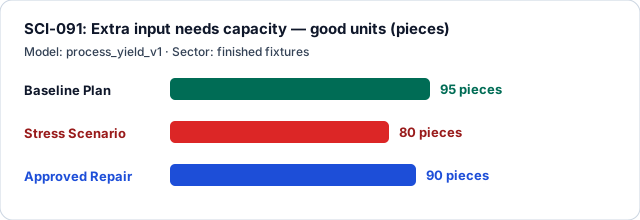
Key Question to Ask: Confirm the declared spare processing capacity before accepting repair.
How to Fix It: Stage enough input before processing at the same lower yield.
Simple Summary of This Example
- Example Number:
SCI-091(finished fixtures) - Plain-English Topic: How Much Extra Raw Material to Start With When Some Output Fails Quality Check
- Main Goal: meet good-output demand
- Important Limit: Extra input assumes material and processing capacity are feasible.
Starting Numbers & Units for SCI-091
| Number Name | Unit of Measure | Starting Value | Allowed Range |
|---|---|---|---|
demand units (demand_units) |
pieces | 90 | 0 to 1000000 (integer) |
planned input (planned_input) |
pieces | 100 | 0 to 1000000 (integer) |
baseline yield percent (baseline_yield_percent) |
percent from zero to one hundred | 95 | 0 to 100 (number) |
stress yield percent (stress_yield_percent) |
percent from zero to one hundred | 80 | 1 to 100 (number) |
Compare Normal Day vs. Problem Day vs. Fixed Plan (SCI-091)
| Result Name | Unit | Normal Day (Baseline) | Problem Day (Stress) | Fixed Plan (Repair) |
|---|---|---|---|---|
good units (good_units) |
pieces | 95 | 80 | 90 |
on time units (on_time_units) |
pieces | 90 | 80 | 90 |
late units (late_units) |
pieces | 0 | 10 | 0 |
processed units (processed_units) |
pieces | 100 | 100 | 113 |
Other Related Examples on "How Much Extra Raw Material to Start With When Some Output Fails Quality Check"
- SCI-085: Input is not good output — A lower process yield reduces shippable units.
- SCI-086: New material trial yield — An approved trial has a different yield assumption.
- SCI-087: Inspection acceptance yield — Final acceptance determines usable output.
- SCI-088: Rework loop consumes input — The toy summarizes recovery as an effective yield.
- SCI-089: Batch start losses — Start-up losses reduce accepted output from a batch.
- SCI-090: Rounding at the wrong stage — Fractional good units are not shippable.
- SCI-091: Extra input needs capacity (This Page)