Example SCI-101: Tool change direction — Changing tools in the two directions takes different time.
What goes wrong: An average setup can hide an overtime requirement. How we fix it: Use the allowed reverse sequence and its documented changeover.
Interactive calculator loads automatically in modern browsers. All plain-English explanations, units, and tables are shown directly on this page.
Visual Before-and-After Chart (SCI-101)
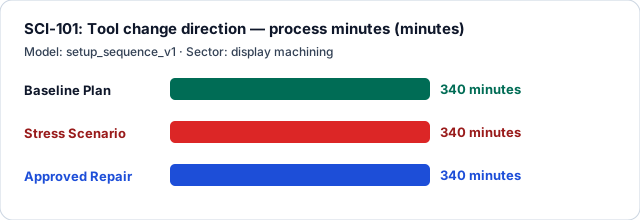
Key Question to Ask: Use the recorded transition rather than one average setup.
How to Fix It: Use the allowed reverse sequence and its documented changeover.
Simple Summary of This Example
- Example Number:
SCI-101(display machining) - Plain-English Topic: How Running Batch B Before Batch A Saves Cleaning Time and Prevents Overtime
- Main Goal: complete both batches within shift
- Important Limit: Both batches have the same due time; order reversal is permitted.
Starting Numbers & Units for SCI-101
| Number Name | Unit of Measure | Starting Value | Allowed Range |
|---|---|---|---|
units a (units_a) |
pieces | 80 | 0 to 1000000 (integer) |
units b (units_b) |
pieces | 60 | 0 to 1000000 (integer) |
time a (time_a) |
minutes per unit | 2 | 0 to 1000000 (integer) |
time b (time_b) |
minutes per unit | 3 | 0 to 1000000 (integer) |
shift minutes (shift_minutes) |
minutes | 420 | 0 to 1000000 (integer) |
assumed setup (assumed_setup) |
minutes | 30 | 0 to 1000000 (integer) |
a to b setup (a_to_b_setup) |
minutes | 110 | 0 to 1000000 (integer) |
b to a setup (b_to_a_setup) |
minutes | 50 | 0 to 1000000 (integer) |
Compare Normal Day vs. Problem Day vs. Fixed Plan (SCI-101)
| Result Name | Unit | Normal Day (Baseline) | Problem Day (Stress) | Fixed Plan (Repair) |
|---|---|---|---|---|
process minutes (process_minutes) |
minutes | 340 | 340 | 340 |
setup minutes (setup_minutes) |
minutes | 30 | 110 | 50 |
total minutes (total_minutes) |
minutes | 370 | 450 | 390 |
overtime minutes (overtime_minutes) |
minutes | 0 | 30 | 0 |
Other Related Examples on "How Running Batch B Before Batch A Saves Cleaning Time and Prevents Overtime"
- SCI-099: A to B is not B to A — The two changeover directions take different times.
- SCI-100: Cleaning direction matters — The permitted product sequence changes cleaning effort.
- SCI-101: Tool change direction (This Page)
- SCI-102: Shared due time permits reversal — Both batches share the same final due time.
- SCI-103: A fast setup still insufficient — A shorter changeover may still leave overtime.
- SCI-104: Maintenance placed between batches — The scenario represents extra time between batches.
- SCI-105: Changeover knowledge captured — An operator explains the directional setup difference.